|
|
Questioning Violence-Justifying Beliefs in South America
an article by Peter C. Newton-Evans
Building a Culture of Peace requires a process of individual and social transformation, and this requires training agents of change, which is the purpose for the Moral Leadership program of Bolivia’s Núr University. Feedback gathered from participants, however, has shown that the assumption that humans are “incorrigibly selfish and aggressive” is burdening potential agents of change with the “paralyzing contradiction” identified by the Universal House of Justice in its 1985 "Promise of World Peace".

click on photo to enlarge
Seeking to address this challenge, a group of Ecuador-based peace educators and activists have been seeking to understand the philosophic and scientific origins of these pessimistic, disempowering beliefs regarding the nature of man and society, and compiling studies by authors in numerous disciplines refuting these mental models and supporting views that bear renewed hope for humanity’s future.
The results have been surprising, as one violence-justifying theory after another has shown either a total lack of empirical evidence, or to have been superseded by more recent research. These include such well-known notions as natural selection for greed and aggression, the law of the jungle, the ubiquity and inevitability of war, the violent brain and killer instinct, the desirability of competition, and many more. They also found that several of these ideas have been used as means for justifying and legitimating diverse forms of structural violence for generations. “It is as if we had been living a centuries-old lie,” says one team member, “one that has become embodied in the every-day normative practices and institutions of our society.”
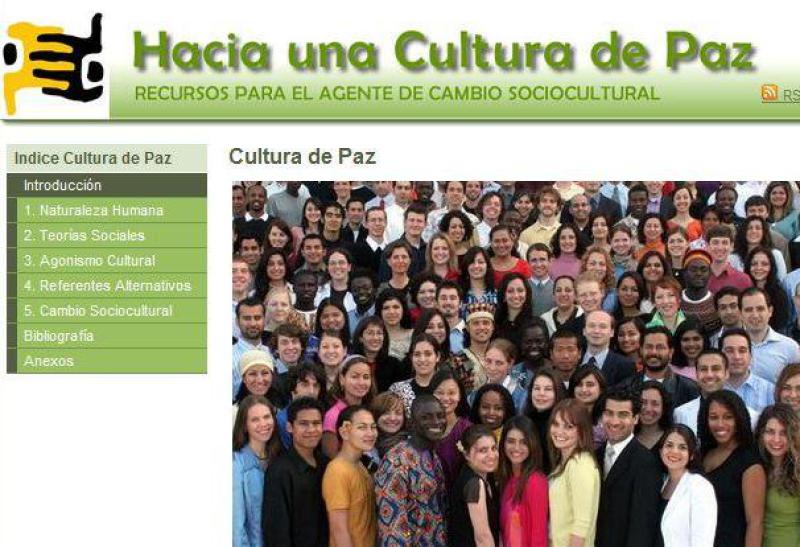
Their findings are freely available to the public at the website Toward a Culture of Peace and have been shared through lectures, workshops and interviews at conferences, universities, organizations, and media in various countries. The enthusiastic response received by these efforts from current and aspiring agents of change suggests that the Latin American region is ripe for a change towards a Culture of Peace. You are welcome to visit the site and suggest a speaking venue.
(Click here for a Spanish version of this article)
|


|
DISCUSSION
Question(s) related to this article:
What arguments do people use to claim that peace is not possible?, How have you answered them?
Are nonkilling societies possible?, If yes, what should we be doing? If not, what will happen to us?

|
|


 by program area