|
|
Mandela is the new Africa
an article by Carlos Lopes, Executive Secretary of the Economic Commission for Africa
In every century there are a few names and events
that mark history. When I attended the first
public speech by Nelson Mandela after he was
released from prison I could not have imagined
that this man was going to be the absolute
rallying personality of the century. The reason
why, in that square in front of Cape Town City
Council, I could not have thought so, was not
because I doubted one inch how special and unique
Mandela was, rather, it was because I doubted an
African could be recognised the world over. After
all, he had spent 27 years in prison and did not
create during that period, the commotion that
followed.

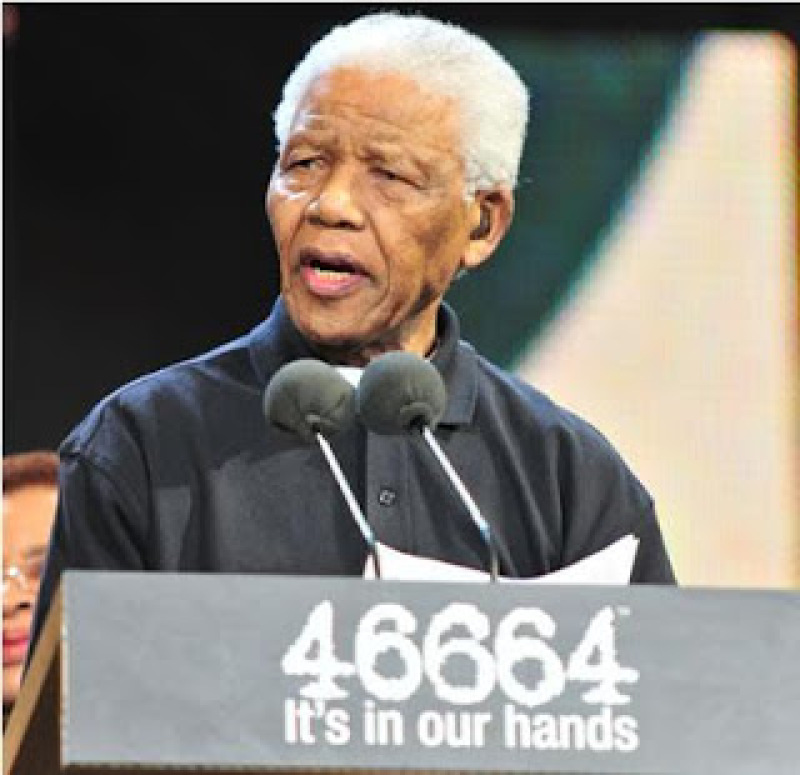
click on photo to enlarge
While in prison, mainstream media should have
crowned him ‘Personality of the Year’ many times
over, but that never happened.
While the Mandela that was liberated remained the
same man at his core, he had surprises to reveal
that nobody could have imagined.
Mandela had time to prepare for what he believed
was inevitable: the end of the most outrageous
institution of the century; and the official
coexistence of a regime proclaiming racial
separation with an international community that
had approved a Universal Declaration of Human
Rights. This paradox was only one of many that
created a platform for Nelson Mandela to
demonstrate that he was different. He espoused
complexity. He was no common hero. He emerged as
the epitome of human dignity.
Mandela was one of the last African leaders who
dedicated their lives to the fight for the
liberation of the continent from the shackles of
colonialism. He is counted among the men and
women who lived, fought and died for the principle
that Africa could manage its own affairs. Kwame
Nkrumah, Julius Nyerere, Amilcar Cabral, Patrice
Lumumba, Oliver Thambo, Nelson Mandela and many
others fought the intellectual, political, social,
cultural, and, sometimes, the military battles
that now enable Africans to live a life they can
claim to better control.
The various stages of the life of this great man
offer us many lessons and points of reflection.
As Africa turns the century, and as we look into
developing a new vision for the continent by 2063,
we must take inspiration from his “long walk to
freedom”.
As a leader, Mandela was father to all, and led
his people through a period of truth and
reconciliation. He personified passion, inspired
us with his actions, and taught by example. He had
a strong sense of character and stood by his
convictions even when it was dangerous to do so.
Mandela has been a great inspiration to me and my
generation. He embodied the unification and
integration of the continent. The struggle for the
total liberation of Africa did not end when
Mandela was released from prison as he said in
that speech in Cape Town.
I would like to add humbly that it cannot end with
his death either, especially now as we develop the
narrative for an African renaissance. Mandela’s
legacy, values and truths will act as a strong
foundation for a united and prosperous Africa.
|


|
DISCUSSION
Question(s) related to this article:
What is the legacy of Nelson Mandela for us today?,
* * * * *
LATEST READER COMMENT:
ON MANDELA'S LASTING LEGACY
In death, as in his life, Nelson Mandela has captured the imagination of the world. Mourning mixed with celebration has electrified crowds all over South Africa and elsewhere. His life’s achievements and his lasting legacy are the topics of discussions. He has been described as a great warrior, a great liberator, the last giant in the fight against colonialism, forgiver, peace maker, and in many other ways.
All this week, Mandela’s lasting legacy has been on my mind. We tend to capture the legacies of great men and women in a word or two. A scientist becomes famous for an important discovery, a writer for a famous book, a musician for a great composition, and so on.
People like Mandela fall in a different category. He is in the category of Mahatma Gandhi and Dr. Martin Luther King. They are known for their fights on behalf of oppressed people; they are known for their personal sacrifice, and for their moral authority. If we are to look for words to associate with these men, it will be ?nonviolence? for Gandhi and ?love? (beloved community) for Dr. King. But what about Mandela- how will we describe his legacy?
What were the important transformational changes in Mandela?s life?
Mandela the great warrior: Mandela has been described as a great warrior, but he was no ordinary warrior. All legendary warriors, mythical or real, are known for the destruction of their enemies. Mandela was different; he did not seek annihilation of his enemy; he transformed his enemy into his collaborator.
Mandela the resilient sufferer: I know of no other person living or dead who was forcefully made to disappear from the scene for this long (incarceration for 27 years) and who survived and made his triumphatic return. Gandhi said there is no other way to show your love for the suffering of your loved ones than to suffer yourself with them, for them. Mandela suffered the longest because his work was the hardest.
Mandela the great liberator: Colonial rulers are known for their ruthless treatment and putting down of citizens but South Africa was not a typical colonial rule. The rulers were Afrikaners, citizen of South Africa. I know of no other country, outside of the United States, where the blacks were so harshly treated by another segment of their own country. It was a true liberation. Thanks to Mandela, sad songs of seeking freedom through death were transformed into freedom in life.
Mandela the magnanimous forgiver: Gandhi?s nonviolence is a complete philosophy of life and it includes love of your enemy and forgiveness. Nonviolence had to be tested to show that it works and that it?s not just a philosophy. Dr. King tested nonviolence with his own suffering and love for his people. His passion for his ?beloved community? became the brand of his civil rights struggle for which he paid with his own life. As Gandhi said, the only two places of non-action for such fighters are prison or death. Mandela went to prison, suffered longer, and tested his resolve to forgive his ?enemy?. We can only imagine the blood bath had he not done that.
Mandela the peace maker: Gandhi, Dr. King and Mandela, together, constitute a shining trinity of peace and their contributions, respectively, nonviolence, love, and forgiveness provide a prescription for peace if the humankind needs to survive. Truth and Reconciliation will remain one of Mandela?s brilliant and innovative contributions for healing wounds between warring people, warring nations. Gandhi, King and Mandela, all tested nonviolence in their own way and they all came out with the same result: The path of peace and liberation goes through love, suffering, and forgiveness.
Mandela the spiritual father: We go through life with two sets of parents. Our own parents, of course, who brought us in this world, whom we owe our life, body and brain, whom we remain eternally grateful for their sacrifice and care to help us grow and to teach us how to live.
There are another set of parents, for a lack of a better word we can call them our ?spiritual parents?. These are men and women whom the whole humanity owes gratitude because it is their discoveries, contributions and, teachings that we like fill our brain with, they make us human- kinder, gentler, and humane.
We call ourselves human because we made a pledge with destiny that we will become humane. It has been a long and arduous journey. With his love, suffering and forgiveness, Mandela has brought us further on the path and has warned we still have a long way to go.
Gandhi-King-Mandela, or Mohan, Martin and Matiba, are angels of peace. We are their descendents, the keepers of their dreams.
Rama Singh, is a professor in the department of biology, and member, Coordinating Council, Centre for Peace Studies, McMaster University.
This appreciation was originally published in the Hamilton Spectator in Canada

|
|


 by program area