|
|
Towards a long-term framework on the culture of peace with young people in the South Caucasus
an article by Meg Villanueva
Let's get past the narrow views about young
people. Youth are not just the “victims” of long-
standing conflicts; we are also agents and actors
that can help support and sustain the development
of the peace process. I remember in 2011, when I
spoke in an international event at the UN, and
addressed some high level representatives that we
are not just the future, but also the “present,”
(after most of their speeches were all about us as
the future!”)

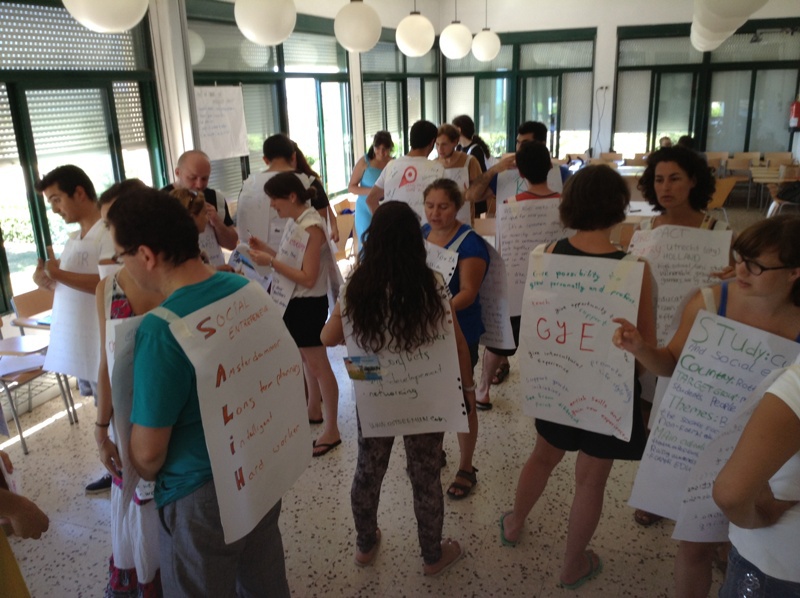
Project coordinators get to know the different organisations through the Sandwichman activity
click on photo to enlarge
In late 2010, I decided to do a mapping of
different peacebuilding initiatives and social
transformation projects led by young people across
Eastern Europe and the Caucasus. I realized that
there were so many (and I mean SO MANY) segregated
and dispersed initiatives on the theme of peace
and conflict. There were just so many good
initiatives and practices – but they were not
connected to each other even though they share the
same theme.
This has led to the idea and motivation of the
project Youth Building Peace: Empowering the
Caucasus, a global 2 year project to create a
strong partnership among organisations in 8
countries in the EU and its neighboring South
Caucasus region and to strengthen capacities of
young people in the field of peacebuilding,
conflict transformation, and intercultural
dialogue - using training and networking as
principal tools.
Last 30 July – 06 August 2013, a Partnership
Building Activity (PBA) was organised by Fundació
Catalunya Voluntària in Barcelona, and brought
together project coordinators/project managers and
staff members from 22 organisations from 8
countries (Armenia, Azerbaijan, Georgia, Germany,
the Netherlands, Russian Federation, Spain and
Turkey). Done with the financial support of the
Youth in Action Programme of the European
Commission, and its Spanish National Agency, the
PBA provided a space and time for all 22
organisations to get to know each other, engage in
different dialogue activities that helped them
understand each others work better and deeper.
As expected, the group realised that the work we
were doing separately would make more sense when
connected to each other. We are all working
towards a similar vision of transforming our
societies by empowering young people anyway, and
so, why not join “forces” together and do
something more long term and more meaningful?
During the 7-day meeting, we came up with three
capacity-building activities which can hopefully be
implemented within the next 12 months. These
activities include:
- a seminar on strengthening the network by
exploring concepts and themes of peacebuilding and
how they relate to the work of the youth
organisations represented (to be held in Georgia and
hosted by the Academy for Peace and Development)
- a series of study visits (one in Armenia and
another in Azerbaijan) to raise the partnership´s
awareness about the context of young people líving
there;
- a Training of Trainers on Peace Education,
which will bring together trainers, multipliers and
educators to explore different training and
facilitating techniques and strategies (to be held
in Turkey).
The main theme of the project is centered on the
framework of the culture of peace and peace
education. This means a broad definition of peace,
which includes human rights, gender equality,
sustainable development, democratic participation,
conflict transformation, nonviolence,
intercultural dialogue, etc.
For more information about the global project,
please contact me at pau@catalunyavoluntaria.cat.
|


|
DISCUSSION
Question(s) related to this article:
Is there a renewed movement of solidarity by the new generation?,

|
|


 by program area