|
|
Women and poverty: the hidden face of violence with social consent (India)
an article by Ela Bhatt, 2013 Gandhi Lecture on Nonviolence at McMaster University in Canada (abridged)
Video: Pride of India - Ela Bhatt
. . . I grew up during a time when my country was
fighting for independence, so my generation was
greatly influenced by Gandhian ideas and practice.
Gandhiji enumerated four basic principles to guide
the development of a free India. They were:
simplicity, non-violence, dignity of labour, and
human values. Apply these measures against not
only economic thought, but also to broader
thinking today, and I believe we will find them to
be powerful and useful in seeking solutions. . . .

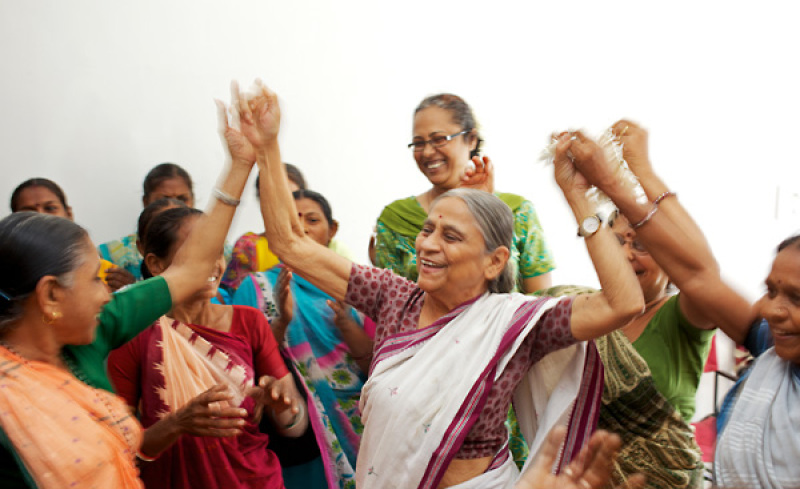
Ela Bhatt with members of SEWA, February 2010
click on photo to enlarge
We can agree that where there is poverty there is
also exploitation and inequality, injustice and
vulnerability, and a constant battle over
resources. Add to that: poor governance, and flaws
in the distribution of resources and services. But
these are human problems arising out of
conflicting and dominating self-interests that
disregard the interests of others. Poverty is not
God-given; it is most definitely man-made. No one
is born poor; society makes one poor.
Gandhiji called poverty a moral collapse of
society, and he believed its roots lie in what he
called the seven social evils. He named them
wealth without work, pleasure without conscience,
knowledge without character, commerce without
morality, science without humanity, worship
without sacrifice, and politics without
principles. Let us keep in mind, Gandhiji wrote
this in 1925.
And indeed, what is poverty but a passive form of
violence? A chronic abuse of human dignity that
strips away a person's humanity, and corrodes the
human spirit? When a woman does back-breaking work
for ten hours a day but cannot feed her family
with her earnings, society has scorned her labour.
When construction workers build housing complexes
but they remain homeless and migrants, society has
snatched away their right to safety and a sense of
belonging. When a woman dies in childbirth,
society shows no regard for her life. When a
farmer grows food for the world, but goes hungry
himself, society is callous. Such are the ways in
which society gives its social consent to let the
situation continue. For this reason, I say that
our silence is violent. Our looking the other way
is a form of consent. It is our moral failure that
we still tolerate poverty. . . .
So let me tell you about our experience at SEWA.
The Self-Employed Women's Association is a trade
union of poor, self-employed women in India. We
have come together to form a union to stop
economic exploitation; we have formed our own
cooperative bank to build assets, to tap
resources, and to improve the material quality of
life. We have built trade cooperatives of women
farmers and artisans, and a trade facilitation
network connecting local and global markets; we
have built a social security network for our
maternity needs, health and life insurance. SEWA
is more than 1.7 million women strong. We come
together not in opposition to anyone, but in
support of each other. Our goal is the well-being
of the poor woman, her family, her work, her
community and the world we all live in. We are in
pursuit of self-reliance and freedom, or as
Gandhiji called it, swaraj. But Mahatma Gandhi
also said swaraj, or freedom, cannot be given; it
is generated within one’s self.
(This article is continued in the discussionboard)
|


|
DISCUSSION
There is no question yet associated with this article.
* * * * *
LATEST READER COMMENT:
(The following is continued from the main article listed above)
A little ‘irregular’ thinking has allowed us to find an approach that looks at what the poor are rich in: their large numbers. My SEWA sisters invariably remind me: we are poor, but we are so many! Their awareness of a collective strength has allowed us to focus on building with hitherto unrecognised strengths, untapped skills, and with non-monetary assets. Our goal is to use work – meaningful, decent work – to build lives, assets and community
In the formal sector, employment is created through the creation of jobs by firms, and this employment is generally regular, full-time, protected employment, with a clear employer-employee relationship; However, in the informal sector there are no ‘jobs’. Employment is a combination of self-employment or own-account work, some wage employment, some casual work, or part-time work with a variety of employment relations. At any one time a poor person could be working at a number of different employments : For example, a small or marginal farmer also works as a weaver or basket maker; or an agricultural labourer would also have cattle and be a milk producer; or a construction worker would return home and roll bidis or cigarettes with her family at night. Sometimes the work is seasonal - A salt farmer may be an agricultural worker during the monsoon season, or a rag picker may make kites during the kite festival. Multiple forms of work are the norm among the working poor, and this risk distribution is key to their survival. Though managing many types of work has its own challenges, it reduces risk, and provides opportunity to rearrange work and life as it unfolds
Creating employment is not a matter of creating jobs in the formal sector, but of strengthening the workers and producers who are already working in the informal sector to overcome structural constraints and enter markets to maximise their potential, Needless to say, those constraints and markets are created by society and such constraints and markets let the poor remain poor
As a labour union, our underlying approach is to see the poor as workers and producers rather than just as income-deprived or vulnerable people. The first structural issue is their place in the economy. Where do they fit into the economy? What is their contribution to the economy and what do they receive from the economy? What are the economic barriers they face?
Our economic structures are closely connected with social structures. Barriers, for example, are closely connected with gender, caste and class. Furthermore, social needs such as health, childcare, education and housing are all linked to economic capabilities, but also to the provision of social security by the state. Thus, market and state structures have the ability to determine poverty as well as the well-being of the people.
The interrelated nature of these structures emerges quite forcefully in our daily work. In dry rural areas for example, the provision of drinking water is closely linked to the capability of women to enter the labour markets, so that when we try to intervene to link the embroiderers with markets, we find that we have to also take up the drinking water issue with the Gujarat Water Board and devise better drinking water schemes for the women. Similarly, while organising women workers for better wages in tobacco processing plants, we were faced with the need for childcare for their children who otherwise would be spending their days playing in tobacco heaps, breathing tobacco dust while their mothers worked. SEWA Bank is one of the pioneers of micro-credit. Very early on, we discovered that without helping the small entrepreneurs deal with changing markets and policies, we could not expect the loans to work towards poverty reduction.
Since the economic and social structures are so interrelated, the solutions too have to be integrated. This means that there is no one formula for poverty reduction; rather, it has to be an approach which addresses the various economic and social factors which cause and perpetuate poverty. Hence SEWA?s approach has been an integrated approach, enfolding multiple approaches, where various inputs are needed not one after the other, but simultaneously. Our strategy of poverty reduction is a joint action of struggle and development. We strongly believe that the identification of barriers and hidden structural biases must come from the poor women themselves. Essentially this process itself is one of self-empowerment.
At SEWA we come together as workers and producers. We believe that productive work is the thread that first weaves the family, and eventually a society, together. When you have work, you have an incentive to maintain a stable society. You not only think of the future, but you can plan for the future. You can build assets that reduce your vulnerability. You can invest in the next generation. Life is no longer just about survival, but about investing in a better future. Work builds peace because work gives people roots; it builds communities and it gives meaning and dignity to one?s life.
In my experience, women are the key to building a community. Focus on women, and they will grow roots for their families, and work to establish a stable community. In a woman, we get a worker, a provider, a caretaker, an educator, and a networker. She is a forger of bonds ? she is a creator and a preserver. I consider women?s participation and representation an integral part of the development process. Women bring constructive, creative and sustainable solutions to the world.
Based on my experience with the working poor in India, I would like to see an economy so well integrated with society that a human being's six primary needs are met with resources from a 100 mile radius. I call it the 100 mile principle. If food, shelter, clothing, primary education, primary healthcare and primary banking are locally produced and consumed, we will have the growth of a new holistic economy that the world will sit up and notice.
When we put the human being at the centre, we begin to get a more holistic and integrated view of development. We begin to co-relate our activities with its impact on our own self, on the society we live in, and on the universe we live in. And in this way we restore balance and harmony in the world.

|
|


 by program area