|
|
More Businesses Pursue Triple Bottom Line for a Sustainable Economy
an article by Colleen Cordes, Worldwatch Institute (abridged)
As corporations of all sizes increasingly choose
to monitor and report on their social and
environmental impacts, a growing number of mostly
small and medium-sized companies are going even
further: They are volunteering to be held publicly
accountable to a new triple bottom line—
prioritizing people and the planet as well as
profits.

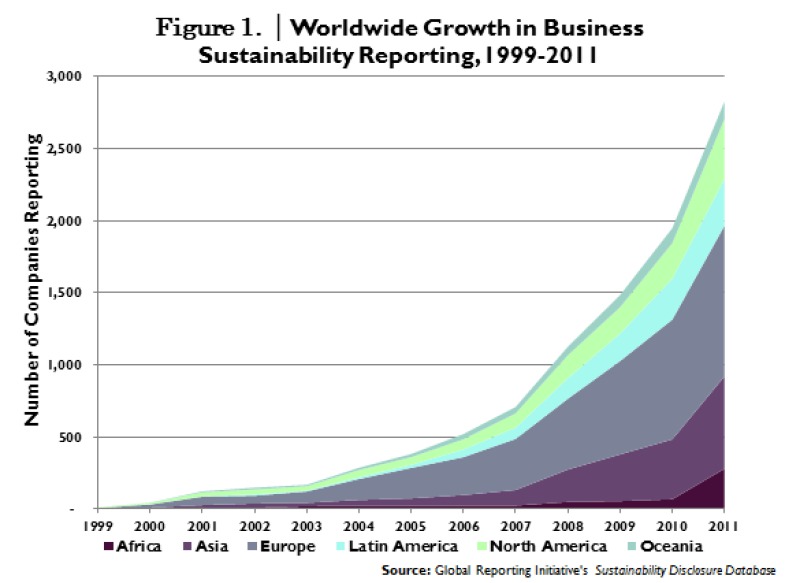
Source: Global Reporting Initiative's Sustainably Disclosure Database
click on photo to enlarge
Just how broadly, rapidly, and rigorously this
movement can spread is of critical importance,
given the supersized global impacts of for-profit
enterprises. Sustainable economies are likely to
remain elusive without substantial shifts in
corporate norms. As I point out in “More
Businesses Pursue Triple Bottom Line for a
Sustainable Economy,” the latest Vital
Signs Online study, recent data provide signs
that such change is possible and indeed may even
have begun.
Over the last 15 years, for example, the number of
businesses of all sizes that choose to self-assess
how sustainable their operations are, using widely
accepted social and environmental standards, and
to publicly disclose their results has been
growing rapidly, especially in Europe and Asia.
Recently there also has been a rise of a fast-
moving movement, with significant leadership
provided by sustainably minded businesses, whose
goal is to persuade lawmakers to create a new
legal status known as “benefit corporation” that
for-profit businesses can choose voluntarily. The
movement for benefit corporation statutes began in
the United States, under the leadership of B Lab,
which developed model legislation with the pro
bono help of U.S. law firms.
A “benefit corporation” is a corporate form that
requires a company to legally establish in its
original or amended articles of incorporation that
it has a general purpose of having a positive impact
on society and the environment . . .
Proponents of this new corporate form say it
essentially bakes a triple bottom line into a
company’s DNA that frees companies from the fear
of shareholder lawsuits if their decisions fail to
maximize shareholder value because of some
competing interest of other stakeholders, such as
workers. Under current corporate case law in the
United States, for example, corporate directors
are generally assumed to be liable in such suits.
Incorporation as a benefit corporation is intended
to establish the directors’ fiduciary
responsibility to consider the interests of all
stakeholders. Formalizing a company’s social and
environmental purposes under a legal framework
also makes it more likely that its good intentions
will survive the departure of its founders or any
major spurts of growth and that its directors will
have the legal backbone to fend off buyout offers
from conventional corporations that do not have
the same commitments.
Most benefit corporations to date are either small
or medium-sized businesses. But they include a few
larger companies that are privately held, such as
the outdoor apparel and accessory firm Patagonia
Inc., which reportedly had annual sales of about
$540 million for the year ending April 2012, and
King Arthur Flour, an employee-owned, 223-year-old
company with reported sales of about $84 million
in 2010. . .
|


|
DISCUSSION
Question(s) related to this article:
How can we get to a sustainable, peaceful economy?,

|
|


 by program area