|
|
Rebirth of the Bibliotheca Alexandrina and the Future of the Arab Spring
an article by David Adams
Video: Ismail Serageldin, Bibliotheca Alexandrina
Now, on the second anniversary of the Arab Spring,
I set out to find a vision of where it is going.
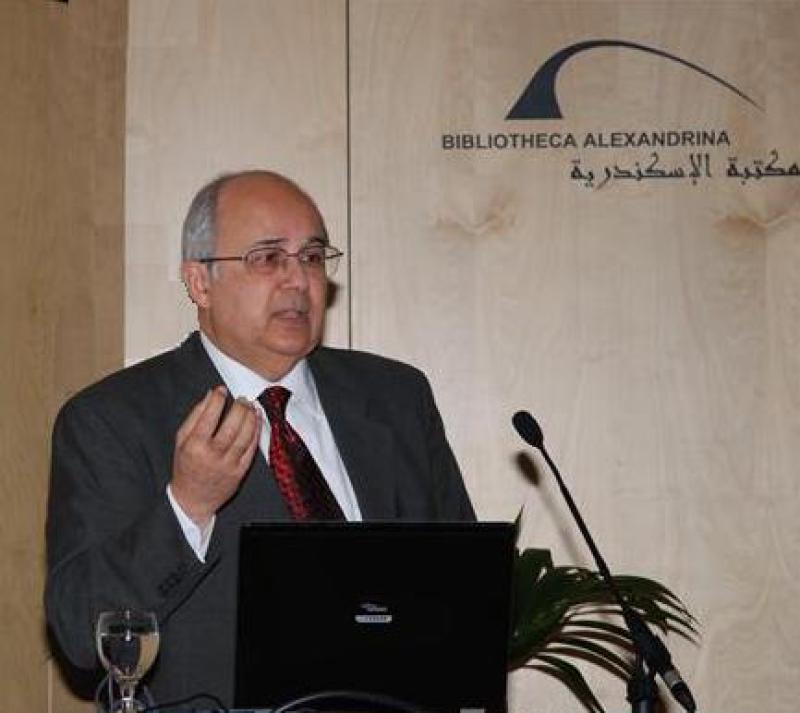
This led me to the truly remarkable talk at the
World Bank (video above) made recently by Ismail
Serageldin, former World Bank Vice President and
now the Director of the Bibliotheca Alexandrina in
Egypt.

click on photo to enlarge
The talk is rather long, over an hour. The first
half of it deals with the history of the original
Bibliotheca which was the center of the
intellectual world for six centuries before and
after the beginning of our era. Serageldin's
description of this history is rich and worth
listening to in its own right, involving Alexander
the Great, Cleopatra, Caesar and Mark Anthony, and
the greatest thinkers and scientists of the
ancient world.
But it is the second part of his talk that is
relevant here, beginning after 55 minutes when he
discusses the events of the revolution in Egypt, in
which the Bibliotheca was deeply involved, and after
65 minutes when he considers its future.
He describes how the new generation of Egyptian
youth, many of whom studied at the Bibliotheca
Alexandrina, armed only with cell phones and
ipads, confronted the troops, tanks and thugs of
the old regime at Tahir Square in Cairo. They
have made the revolution, an "unstoppable wave."
At the height of the violent confrontations, a
million people marched past the Bibliotheca on the
broad avenue that lines the seacoast of
Alexandria. We are very proud, says Serageldin,
that our library has no walls and no gates. We
are open to the people. But, of course, that also
makes us vulnerable. To protect the library, a
long line of youth surrounded it and linked arms
to defend it. As a result, no one of the million
demonstrators who passed broke into the library.
Because the Arab world is key to the larger Muslim
world, and Egypt is key to the Arab world, "a
successful transition to democracy in Egypt with a
liberal version of Islam would have a very
profound impact." "I have five objective reasons
to be optimistic."
1) Non-violence. In Tahir Square after many days
of confrontations involving over a million people,
only three people dead and 250 injured. It's much
less violent than the events in Libya, Syria,
Yemen or Bahrain. People can express their
opinion without fear.
2) Rule of Law. "Secondly, there is an amazing
commitment to the rule of law."
3) Elections: Ballots, not Bullets. And through all
of this "we have had seven elections, not counting
the last referendum." He shows photos of women
lining up to vote, women of all faiths together in
the same line.
4) Deeply divided. "Most people think it is a problem that we are deeply divided, but I don't think so." The country is so deeply divided that neither side can crush the other. "Then what people have to do is to compromise, and that's the beginning of pluralistic politics."
5) Public Participation. "If you had asked me two years ago, I would have told you apathy is the biggest problem. But now, there is much greater public participation: elections, demonstrations, debates, discussions everywhere." We have bloggers and their readers. We have many political parties and many very active women's groups.
|


|
DISCUSSION
Question(s) related to this article:
The Arab spring of 2011, Can it inspire democratic movements around the world?

|
|


 by program area