|
|
United States: Drone Protester Acquitted by Jury
an article by David Swanson
Syracuse July 31, 2014 After two hours of
deliberation,Vietnam Veteran and Buffalonian Russell Brown,
was acquitted tonight by a six person jury in DeWitt Town
Court, East Syracuse. He was facing charges of Obstruction of
Governmental Administration (OGA), a misdemeanor carrying
up to a year incarceration and up to $1000 fine, as well as
Disorderly Conduct charge, a violation. Mr. Brown who went
before the court Pro Se (he served as his own counsel) was
assisted by Buffalo Attorneys Daire Irwin and Paul Fallon. 
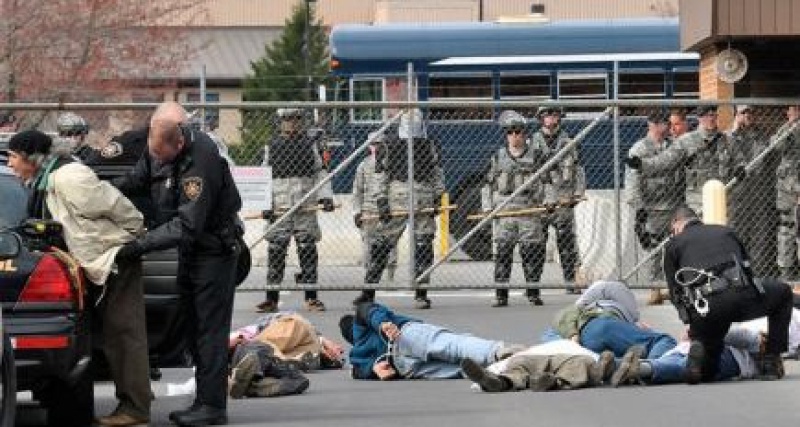
37 people who protest at Hancock Air Base near Syracuse against the use of drones are arrested. Photo by Voices for Creative Nonviolence
click on photo to enlarge
Mr. Brown was arrested during a nonviolent protest at
Hancock Air National Guard Base on April 28, 2013. In a
roadway across from the Airbase, he lay down to symbolize
the death of drone victims. There are biweekly
demonstrations at Hancock Airbase. Several times a year
there are larger demonstrations and nationally coordinated
events. On six occasions there have been arrests, leading to
six trials since 2011. Mr. Brown's trial is the second acquittal.
There are twenty activists are facing prosecution, working with
Upstate Drone Action.
During testimony, Russell told what he did leading up to the
"Global April Days of Action" gathering in Syracuse. This
included his writing a poem that links the drone attacks
conducted at Hancock with the missions he conducted in
Vietnam. A marine from 1965 - 1967, he told of the war he
experienced. His participation in senseless killing and
brutality in Vietnam informed his understanding of the Drone
War Program at the 174th Attack Wing. Russell now finds
allegiance with the victims of the drone attacks.
Laying on the street with "blood" spattered clothes lifted a
weight of guilt from Russel. Transforming guilt to regret
makes possible a voice: poet, marcher in a 'legal' protest,
drone victim laying in the street were deemed protected
speech. The message was closely attended by the jury. Brian
Hynes said, "They saw the human power of the message and
the public value of the method used to deliver it. Drones kill
senselessly and illegally and traumatize our airmen."
Russell said that the wars of the last decade brought back his
experiences in Vietnam. “Lying in that road was the most
peaceful moment I've experienced since I left Vietnam,” he
said. "I was silent then in the face of those atrocities and I
can't be silent anymore."
The jury was smiling as they returned to give the verdict. Later
one juror asked a supporter to "Thank Russell for us! My
brother was in the Vietnam War and lost his leg. We know
what the vets went through." The juror also acknowledged
the PTSD drone pilots experience. Another juror said, "We did
what was needed to be done. It was fair and just".
|


|
DISCUSSION
Question(s) related to this article:
Drones (unmanned bombers), Should they be outlawed?
* * * * *
LATEST READER COMMENT:
Finally a Drone Report Done Right
By David Swanson
The U.N. and Human Rights Watch and Amnesty International recently released a flurry of deeply flawed reports on drone murders. According to the U.N.'s special rapporteur, whose day job is as law partner of Tony Blair's wife, and according to two major human rights groups deeply embedded in U.S. exceptionalism, murdering people with drones is sometimes legal and sometimes not legal, but almost always it's too hard to tell which is which, unless the White House rewrites the law in enough detail and makes its new legal regime public.
When I read these reports I was ignorant of the existence of a human rights organization called Alkarama, and of the fact that it had just released a report titled License to Kill: Why the American Drone War on Yemen Violates International Law. While Human Rights Watch looked at six drone murders in Yemen and found two of them illegal and four of them indeterminate, Alkarama looked in more detail and with better context at the whole campaign of drone war on Yemen, detailing 10 cases. As you may have guessed from the report's title, this group finds the entire practice of murdering people with flying robots to be illegal.
Alkarama makes this finding, not out of ignorance of the endless intricacies deployed by the likes of Human Rights Watch and Amnesty International. Rather, Alkarama adopts the same dialect and considers the same scenarios: Is it legal if it's a war, if it's not a war? Is it discriminate, necessary, proportionate? Et cetera. But the conclusion is that the practice is illegal no matter which way you slice it.
This agrees with Pakistan's courts, Yemen's National Dialogue, Yemen's Human Rights Ministry, statements by large numbers of well-known figures in Yemen, and the popular movement in Yemen protesting the slaughter. While the other \"human rights\" groups ask President Obama to please lay out what the law is, whether his killing spree is part of a war or not, who counts as a civilian and who doesn't, etc., Alkarama actually compares U.S. actions with existing law and points out that the United States is violating the law and trying to radically alter the law. This conclusion results in a clear and useful set of recommendations at the end of the report, beginning with this recommendation to the U.S. government:
\"End extrajudicial executions and the practice of targeted killings by drones and other military means.\"
This recommendation is strengthened by a better informed and more honest report that much more usefully conveys the recent history of Yemen (including by noting honestly the destructive impact of the IMF and the USA), describes the indiscriminate terror inflicted by the buzzing drones, and contrasts drone murders to alternatives -- such as negotiations. This analysis enriches our understanding of why drone wars are counterproductive even from the point of view of a heartless sociopath rooting for Team USA, much less someone concerned about human rights.
It is, then, possible to write a human rights report from a perspective concerned with the rights of humans, and not some combination of concern with human rights and devotion to U.S. imperialism. This is good news for anyone interested in giving it a try. The field is fairly wide open.
Some nations' statements at the U.N. debate on drones this month, including Brazil's, also challenged the legalization of a new form of war. And all of these groups and individuals have something to say about it as well.

|
|


 by program area