|
|
More Women Sit on the UN Security Council, but What Does It Mean?
an article by Mirva Lempiainen, PassBlue
As increasing numbers of women embark on careers as
diplomats, the United Nations headquarters in New
York is slowly but surely undergoing a big change in
demographics: the female-to-male ratio of diplomats
is becoming — dare it be possible — more balanced.

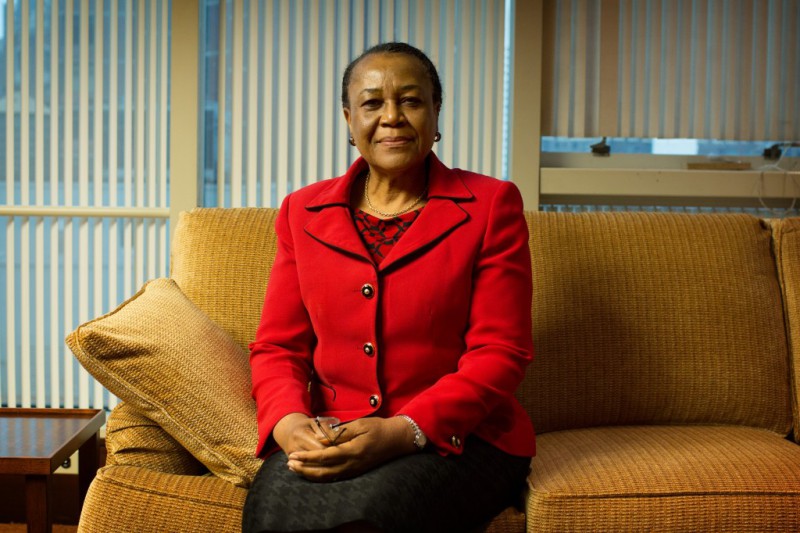
Joy Ogwu, the Nigerian ambassador to the United Nations and the president of the Security Council in April 2014, shown in her office. Photo by Joe Penney
click on photo to enlarge
Of the UN’s 193 member countries, about 30 women
currently represent their nations as permanent
representatives, a record of 15 percent. This
Group of 30, as they are nicknamed in UN circles,
may not appear seismic, but at the world body, a
male bastion since its start in 1945, it is a
meaningful number. As more women have been
assigned to the UN as ambassadors for their
countries, they have become a larger presence on
the Security Council, the UN’s most important
body. Of the 15 council members, five are now
women, representing Argentina, Lithuania,
Luxembourg, Nigeria and the United States.
“It’s quite a significant development,” said Joy
Ogwu, the ambassador of Nigeria and the president of
the council in April, a rotating position.
Ogwu as president marks the third month in a row
that a woman has been leading the proceedings of
the Security Council, which is addressing such
sticky situations as a rebellion in South Sudan
and a risk of genocide in the Central African
Republic as well as long-term mandates on its
agenda. The council is also meeting on the crisis
in Ukraine and on the long war in Syria. Sylvie
Lucas of Luxembourg held the presidency in March;
in February, it was Lithuania’s turn, led by
Raimonda Murmokaite.
The rise of women at the UN has been noticed. “It
seems the world is fascinated by this phenomenon,”
Ogwu said during an interview in her office, near
the top of Nigeria’s high-rise UN mission on Second
Avenue, a block from the world body.
Ogwu said that the media first started paying
attention to the increasing numbers of women
diplomats in 2010, when the Security Council had
three women for the first time: Ogwu; Susan Rice
of the US; and Maria Luiza Ribeiro Viotti of
Brazil. Rice returned to Washington, D.C., to
become the national security adviser in the Obama
administration and has been replaced by Samantha
Power, a human-rights expert with a Harvard law
degree and at one time a journalist. Ribeiro is
now Brazil’s ambassador to Germany.
Since 2010, the percentage of women in the Security
Council has risen to 33 percent. “We do hope that
this is a trend, actually,” Ogwu said.
The trend of female leaders is evident globally, as
the number of female parliament members has been
going up, often through national quotas, which has
helped more women get elected into high office.
(Thank you to Janet Hudgins, the CPNN reporter for
this article.)
(This article is continued in the discussionboard)
|


|
DISCUSSION
There is no question yet associated with this article.
* * * * *
LATEST READER COMMENT:
(The following is continued from the main article listed above.)
That number peaked at 33 from 2000 to 2009, but it has since dropped to 19, according to the National Democratic Institute, a nonprofit group in Washington whose board chairwoman is Madeleine Albright, a former American ambassador to the UN.
In 1960, just three women were heads of state or government; since then, a total of 94 women have been leaders of 67 countries. Regionally, Europe claims the most women who have served in the highest office (39), followed by Latin America and the Caribbean (18), Asia (16), Africa (15), Oceania (Australia, New Zealand and Pacific Island nations, at 3), Middle East (2) and North America (Canada, 1).
At the Security Council, the female ambassadors sometimes consult together about their work, Mark Lyall Grant, the UN ambassador of Britain and a permanent council member, said in a phone interview.
This type of closeness does not happen nearly enough, Ogwu noted. “We don’t see ourselves as a collective,” she said of the women in the council, adding that she would like to see real change come from women’s increased presence in the UN.
“We have to make a conscious effort as a collective to apply the inherent attributes of women,” she said, singling out such instincts as being protective, nourishing, tender, nurturing and loving — traits that could be perceived as weak and stereotypical by some leaders from other cultures.
It’s not that men don’t possess these attributes, Ogwu said. “They do, but most times they are reluctant to exhibit it. It’s unmanly to exhibit it.”
Ogwu, who has been a UN ambassador for nearly six years and has raised four children during her career, is not suggesting that men should be pushed aside. “In any case, we cannot do anything without them,” she said. “Complementarity is the key word.”
“If they are alienated, we will have more problems in our hands,” she continued. “But if we bring them along, side by side, working with us, we’ll have a better world.”
Sylvie Lucas of Luxembourg conveyed similar sentiments. ?Ambassador Lucas is of course very pleased that there are this year, for the first time ever, five women Ambassadors serving on the Security Council,? Jacques Flies, a counselor at the mission, wrote in an email.
Women are ?frequently highlighting the need to make women fully participate in the negotiations surrounding peacekeeping and peace-building efforts,? Flies said. Given that the council passed a resolution in 2000 mandating such roles for women, this goal should be automatic. Yet only one formal peace negotiation has women participating so far, the Colombia talks. Some feminists say the women engaged in these talks are proxies for the government and do not represent grass-roots constituents.
Lyall Grant noted a similar change of emphasis reflected in the council. ?In a post-conflict situation, men are focused on why the conflict took place; women focus on getting life back to normal,? he said, adding that both viewpoints are necessary.
Some council members prefer to play down the increased presence of women, emphatic that diplomats are first and foremost representatives of their country.
?I think it?s more that question of symbolism: that women can do things, they do things, as good as anybody,? Murmokaite of Lithuania said in an interview in the East Lounge of the UN in February.
Murmokaite, who speaks in a soft but firm voice in her British-inflected English, said she found great importance in more women becoming ambassadors and thus serving as role models for younger women who are trying to figure out their careers.
?Showing that a woman can reach that level and can make a difference is extremely important for somebody who is looking for a path in life,? she said, adding that combining a high-profile UN career and a family can be difficult.
?This position takes a lot of your time and it wouldn?t be easy to balance,? Murmokaite, who is single, said. ?I respect those that balance it all out.?
Murmokaite noted, however, that 5 of the 15 Security Council ambassadors being women is not a cause for celebration. Instead, ?it does show that there? a long way to go, and that the Security Council temporarily is in a better position than the whole membership of the UN.?
Ogwu agreed on the value of having strong, articulate women in power ? but not just as emblems for girls.
?Even our sons need to see us as models,? she said. ?They have to see us as vital contributors to the stability of one ? the family; two ? the community; and three ? the world.?
?As usual, as women, you have to prove yourself many, many more times over,? Ogwu added. ?Let?s face it, it?s still a patriarchal world.?
To get their points across, she said the women come to the Security Council extremely well prepared, revealing their thorough knowledge about the issues at hand.
In reality, women often occupy more than a third of the Security Council seats, Lyall Grant said, as many countries have a woman as a deputy ambassador or as a political counselor.
These people sit in for the permanent representative, or P.R. as they are called, when the ambassador cannot make it to a high-level meeting. The deputy of Samantha Power, for example, is a woman: Rosemary DiCarlo, a longtime member of the UN mission. She was president of the council in July 2013, after Rice left for Washington and before Power was approved by the US Senate for the ambassadorship.
?It?s only been on three occasions that all 15 P.R.s have been in the same room,? Lyall Grant said of his four years in the Security Council. In a normal meeting, about three to six permanent representatives are absent ? on holiday or ill.
Murmokaite said she had been in the council chambers with up to six women at one time. ?For me personally, the numbers don?t matter that much. It?s the substance, what they bring as individuals,? she said. ?Definitely, every single woman that is in that room is a strong personality and brings a lot of very pertinent issues to the discussion.?
Contrary to stereotypes, emotional displays are not confined to women at the council table.
?Men can be as emotional about some issues as women, particularly when it comes to the horrible things we are discussing there. You know, hundreds of thousands of lives lost. It just touches a nerve for everybody,? Murmokaite said.
As for the gender balance of the council in the future, Lyall Grant said he had no doubt that the trend of having more women on board will last. ?There will become a time, for sure, when there will be a majority women P.R.s. That will be a milestone.?
Ogwu can?t help but wonder about the ramifications of that moment. ?What would happen? Would attitudes change, would there be less conflict in the world?? she asked, unable to answer.

|
|


 by program area