|
|
Nouvelle Constitution, un moment clé pour la démocratie en Tunisie
an article by Union interparlementaire - Note de presse
L’Union interparlementaire (UIP) a félicité la
Tunisie qui adoptait aujourd’hui même sa nouvelle
Constitution, un texte qui consacre la liberté de
religion et l’égalité entre les hommes et les
femmes.

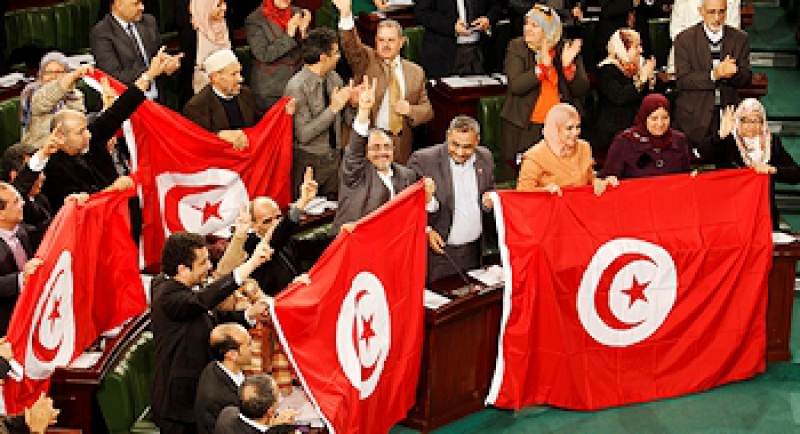
Les membres de l'Assemblée nationale constituante de la Tunisie célébrant l'adoption de la nouvelle Constitution du pays, trois ans après le mouvement de contestation qui a abouti au renversement du Président Zine el-Abidine Ben Ali. ©REUTERS/Zoubeir Souissi
click on photo to enlarge
Dans une lettre à l’Assemblée nationale
constituante tunisienne, le Président de l’UIP,
Abdelwahad Radi a salué cet événement, estimant
que l’adoption de cette Constitution resterait
dans les annales de la Tunisie comme le jour où
elle s’est dotée « d’un socle solide sur lequel
édifier un Etat moderne et démocratique ».
Cette nouvelle Constitution adoptée par une
majorité écrasante (200 voix sur un total de 216)
a non seulement été validée par consensus, mais
elle représente en outre les différents groupes et
croyances qui composent la société tunisienne. Le
Président Radi y voit un « immense accomplissement
».
Le Président de l’UIP a félicité les membres de
l’Assemblée nationale constituante « d’avoir su
répondre avec un tel brio aux attentes du peuple
tunisien ».
Il a mis en avant les aspects de la Constitution
qui auront un effet profond sur la démocratie en
Tunisie.
“La garantie de la liberté de religion, de
l’égalité entre hommes et femmes et d’un Etat
responsable de protéger les femmes de la violence
sont des piliers fondamentaux pour la démocratie.
Ces principes font partie des convictions et des
aspirations essentielles de notre organisation –
l’UIP – dont la Tunisie fait partie», a-t-il dit.
L’UIP note en particulier l’inclusion dans la
nouvelle Constitution tunisienne d’une disposition
garantissant la parité au Parlement et dans les
autres institutions élues.
Depuis les changements politiques qui ont débuté
en Tunisie fin 2011, l’UIP a noué un dialogue
actif avec les autorités, les femmes politiques et
les organisations non-gouvernementales, en vue de
contribuer à la mise en place d’un nouveau cadre
législatif réaffirmant expressément les principes
de liberté de conscience et de religion, ainsi que
d’égalité entre hommes et femmes.
L’UIP se tient à la disposition de la Tunisie pour
lui apporter toute l’aide et tout le soutien qui
pourront lui être utiles pour faire de cette
Constitution approuvée par le plus grand nombre une
réalité pour tous les citoyens tunisiens.
( Cliquez ici pour une version anglaise)
|


|
DISCUSSION
Question(s) related to this article:
The Arab Spring, Can Tunisia continue the momentum they started?
* * * * *
LATEST READER COMMENT:
The following commentary is translated from Martine Gozlan in Marianne
No, the Sharia is not being applied, and yes, the charge of apostasy is prohibited. No, Islam is no longer the source of law, and yes, the woman is the equal of the man . And freedom of conscience is protected. Tunisians, with a minimum of violence and a maximum of reason, have fought for a constitution that rejects obscurantism and opens the door to a secular hope in the Arab world.
Moreover, there is no longer the choice of the bearded or the képi. If Islam is to bite the dust, there must tanks in the streets. And the Islamists, of course, have the hideouts and the explosives. Moreover, there is no choice: it is blood for blood and the exclusion of the other from the making of history. And besides, they touched the Tunisian people, who rejected it. The people rejected it clearly with all their force. The dead could be counted on the fingers of one hand but it was already too much. Those who began to drift towards the shores of unreason, tempted by the savage and radically alien, they were driven back by protests, despite how the lyrical illusion and thirst for revenge that follows every revolution miraculously gave them power. But it was a power lent by the people, and they could not hold onto it when they tried to claim a pseudo- democratic eternity of divine right !
And look at Tunisia now! Tunisian society has become secular and open, with a dynamic opposition, obtained through struggle for a Constitution that will safeguard freedoms, despite the opposition of the Islamists. No, Islam is no longer the source of the law, and this definitely excludes Sharia religious law. Yes, to accuse a citizen of apostasy for renouncing Islam is now a crime. This is a first in the Arab world! And should the amendment of Article 6, which was fiercely debated, a major fault of a new member of Ennahda famous for his poor skills of dialogue skills: the so-called Habib Ellouze, who for three years cajoled Saudi jihadist preachers and lost, and who rained a hail of insults and threats on the opposition MP who defended secular ideas. The violence of his outbursts sparked such a strong reaction that the amendment was passed. As a result, we can no longer speak of apostasy in Tunisia !
RESULT : JABEUR MEJRI MUST BE RELEASED, BASTILLE FOR ATHEISM !
That would be the logical and immediate result of the fantastic awakening of consciousness that inspired the vote on this amendment.
But not too fast! They have not yet completely won, these Tunisiens with their civil state and the freedom of conscience enshrined in the texts. Nadia el Fani, the magnificent and celebrated director of \"Laïcité Inch Allah!\", so often threatened and insulted, tells me that I am much too naive to be a Tunisien:
\"Be careful. Don't forget that article 1 that dates from the era of Bourguiba, remains in place, stating that Islam is the religion of the State! This may not dictate the law, but it should trouble us just the same. And the new constitution still begins with an invocation to god: 'In the name of Allah, the all-powerful and all-compassionate.\" Perhaps you find that secular? And on Facebook, the comments are unrestrained!\"
In sum, what seems like the end is only a beginning. They are ready to do battle over and over on the unstable field of interpretations. They are not kidding. They have decided to go all the way!
And on the other side, the Islamists have not said their last word. The Prime Minister must announced his Cabinet on January 9 and a new government must start working in a very difficult economic situation. As of January 14, the revolution will celebrate its third birthday. The struggle continues. One step after another towards the refusal to negate the other.
Formidable Tunisie!

|
|


 by program area