|
|
Tunisia opts for civil, not Sharia law as assembly votes on new constitution
an article by RT News (abridged)
Tunisia has rejected Islam as the source of its
laws, with the country’s Islamist-dominated
constituent assembly voting to adopt new articles
amid fears that ongoing disagreements may derail
the constitution altogether.

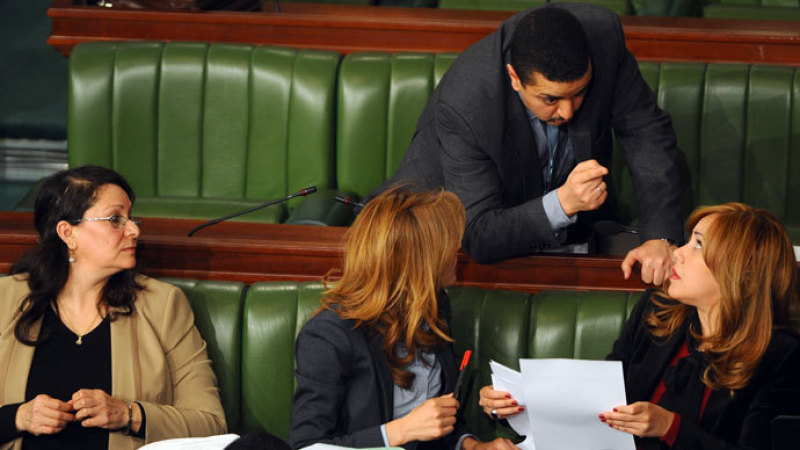
Tunisian Islamist MP and General Rapporteur of the constitution Khedher Habib speaks with his colleagues during a meeting of the Constituent Assembly on January 3, 2014 in Tunis. (AFP Photo / Fethi Belaid)
click on photo to enlarge
The country that in 2011 gave birth to the Arab
Spring has adopted new articles in its upcoming
constitution, the first two of which state that
Tunisia is a “civil” republic based on the rule of
law, but with Islam remaining as its state
religion. After Saturday’s vote [January 4], 12
of the 146 articles discussed have now been
adopted.
The articles received harsh criticism from
opponents, some of them believing that an absence
of Islam from the legal framework would open the
door to “Satanism and idolatry.” In fact, the
assembly, which was set up in 2011 to establish a
new constitution after the uprising that removed
the then-president, Zine el-Abdine Ben Ali, was
plagued by so much infighting that there are fears
that the January 14 deadline for ratifying the new
constitution would not be met, AFP reported.
Although a secular country during the former
president’s rule, months of violent political
unrest and assassinations opened the door for new
ideas on how the country should be run. But
Saturday’s vote put that on hold, retaining
Islam’s position only as a moral – not legal –
authority.
While Islam will remain the state religion, the
government, under one of the newly accepted laws –
Article 6 – will become “the guardian of
religion,” “protector of the sacred” and shall
guarantee “freedom of conscience,” something that
has been hotly debated even by the law’s
proponents, for fear of misinterpretation by those
in power.
Saturday’s vote also rejected two amendments under
which the Koran and Sunna – the acts, sayings and
judgments of the Prophet Mohammed – as well as
Islam itself, were to have legal power.
By implication, mosques would no longer be
associated with, or used for, political activity.
The assembly was set to convene again Sunday to
proceed with other articles. The new constitution
will need to receive more than 140 votes, which is
two-thirds of the 217-member assembly. If not, it
will be put to a referendum.
Tunisian politicians hold very differing points of
view on Islam’s place in law and civil society.
Human rights activists have welcomed the votes,
seeing that religious courts with serious
consequences for the individual have been
prevented; while those advocating freedom within
an Islamic framework argued that even with Islam
as the source of law, people would have nothing to
fear for their freedoms, because Islam would give
its “spiritual backing” and support them. One
such belief comes from a party calling itself the
“Current of Love.”
But backers of Islam were unrelenting in their
view that under the new law, virtually any other
belief known to man could flourish.
Other, more secular politicians, like Mahmud
Barudi of the Democratic Alliance, believe that
adopting amendments under which Islam and its
religious texts are law was equal to living in the
past.
To counter the proponents of the view that a lack
of Islam in the legal framework would allow
“Satanism” to thrive, the ruling Ennahda party’s
Sonia Ben Toumia said that “Islam is a religion
that guarantees freedom of religious practice to
others” . . .
[Note: Thank you to Kiki Chauvin, the CPNN
reporter for this article.]
|


|
DISCUSSION
Question(s) related to this article:
The Arab Spring, Can Tunisia continue the momentum they started?
* * * * *
LATEST READER COMMENT:
The following commentary is translated from Martine Gozlan in Marianne
No, the Sharia is not being applied, and yes, the charge of apostasy is prohibited. No, Islam is no longer the source of law, and yes, the woman is the equal of the man . And freedom of conscience is protected. Tunisians, with a minimum of violence and a maximum of reason, have fought for a constitution that rejects obscurantism and opens the door to a secular hope in the Arab world.
Moreover, there is no longer the choice of the bearded or the képi. If Islam is to bite the dust, there must tanks in the streets. And the Islamists, of course, have the hideouts and the explosives. Moreover, there is no choice: it is blood for blood and the exclusion of the other from the making of history. And besides, they touched the Tunisian people, who rejected it. They are known for their fights on behalf of oppressed people; they are known for their personal sacrifice, and for their moral authority. If we are to look for words to associate with these men, it will be ?nonviolence? for Gandhi and ?love? (beloved community) for Dr. King. But what about Mandela- how will we describe his legacy?
What were the important transformational changes in Mandela?s life?
Mandela the great warrior: Mandela has been described as a great warrior, but he was no ordinary warrior. All legendary warriors, mythical or real, are known for the destruction of their enemies. Mandela was different; he did not seek annihilation of his enemy; he transformed his enemy into his collaborator.
Mandela the resilient sufferer: I know of no other person living or dead who was forcefully made to disappear from the scene for this long (incarceration for 27 years) and who survived and made his triumphatic return. Gandhi said there is no other way to show your love for the suffering of your loved ones than to suffer yourself with them, for them. Mandela suffered the longest because his work was the hardest.
Mandela the great liberator: Colonial rulers are known for their ruthless treatment and putting down of citizens but South Africa was not a typical colonial rule. The rulers were Afrikaners, citizen of South Africa. I know of no other country, outside of the United States, where the blacks were so harshly treated by another segment of their own country. It was a true liberation. Thanks to Mandela, sad songs of seeking freedom through death were transformed into freedom in life.
Mandela the magnanimous forgiver: Gandhi?s nonviolence is a complete philosophy of life and it includes love of your enemy and forgiveness. Nonviolence had to be tested to show that it works and that it?s not just a philosophy. Dr. King tested nonviolence with his own suffering and love for his people. His passion for his ?beloved community? became the brand of his civil rights struggle for which he paid with his own life. As Gandhi said, the only two places of non-action for such fighters are prison or death. Mandela went to prison, suffered longer, and tested his resolve to forgive his ?enemy?. We can only imagine the blood bath had he not done that.
Mandela the peace maker: Gandhi, Dr. King and Mandela, together, constitute a shining trinity of peace and their contributions, respectively, nonviolence, love, and forgiveness provide a prescription for peace if the humankind needs to survive. Truth and Reconciliation will remain one of Mandela?s brilliant and innovative contributions for healing wounds between warring people, warring nations. Gandhi, King and Mandela, all tested nonviolence in their own way and they all came out with the same result: The path of peace and liberation goes through love, suffering, and forgiveness.
Mandela the spiritual father: We go through life with two sets of parents. Our own parents, of course, who brought us in this world, whom we owe our life, body and brain, whom we remain eternally grateful for their sacrifice and care to help us grow and to teach us how to live.
There are another set of parents, for a lack of a better word we can call them our ?spiritual parents?. These are men and women whom the whole humanity owes gratitude because it is their discoveries, contributions and, teachings that we like fill our brain with, they make us human- kinder, gentler, and humane.
We call ourselves human because we made a pledge with destiny that we will become humane. It has been a long and arduous journey. With his love, suffering and forgiveness, Mandela has brought us further on the path and has warned we still have a long way to go.
Gandhi-King-Mandela, or Mohan, Martin and Matiba, are angels of peace. We are their descendents, the keepers of their dreams.
Rama Singh, is a professor in the department of biology, and member, Coordinating Council, Centre for Peace Studies, McMaster University.
This appreciation was originally published in the Hamilton Spectator in Canada.

|
|


 by program area