|
|
Citizenship puts journalism to the test
an article by Gwenaëlle Beauvais
In September 2010, a public French television channel broadcast a shocking documentary which claimed to show machismo in the suburbs. The extremely violent sentiments of young people that were shown caused a big controversy, which inflamed the social-cultural tensions in the neighborhood. Ladji Real, a young filmmaker and documentary director, returned to the location of the filming in Vitry sur Seine to conduct his own investigation.
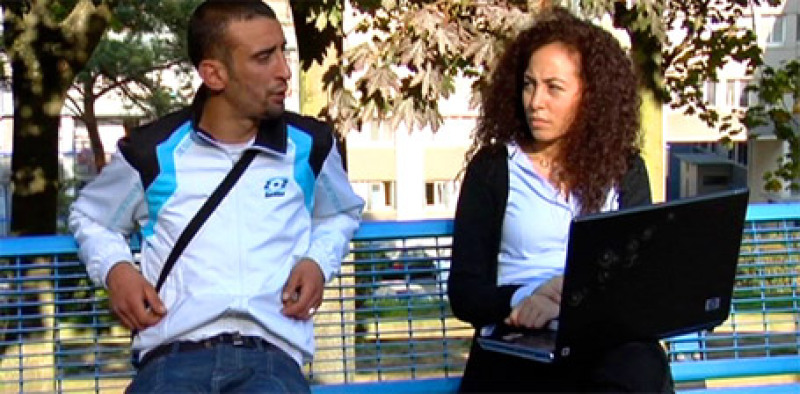
Journalist Ager Oueslati interviewing a resident of the neighborhood, drawn from the counter-investigation filmed in Vitry by Ladji Real
click on photo to enlarge
What he found was the anger of the people there, which are said by the protagonists of the documentary to have been "misinterpreted". The director of the original film apparently took this out of context in order to support her script. Concerned by what he had heard, Ladji Real began filming a “counter investigation” in an attempt to restore reality.
In December 2010, he organized a press conference in Paris to present his work The City of Evil (La cite du mal), a play on words from the original documentary The city of the male (La cite du male). This self-produced documentary still has not been broadcast.
Curious to understand what had happened, I went to ask him some questions. Here are my questions along with the response by Ladji Real to the last question. The full interview may be seen here or on the right side of the page.
1. What ethical "laws" should be respected, which were not respected in "The city of the male” ?
2. What is the message for the younger generation of this “counter-investigation”?
3. In your opinion, is this behavior common among journalists?
4. Obviously this raises questions about the moral role that journalism plays in our societies. Do you think we can have a journalism that is more responsible with regards to citizenship.?
We need a return to ethics. Why not start a real discussion and debate within the profession? There an order of medicine which is regulated and enforced. When will there be such an order of journalists? I think the work of journalism should be much more responsible than it is today. Journalists should help to ensure a climate of peace and not the opposite.
(This article is continued in the discussionboard - see righthand column of this page)
Click here for the original of this article in French.
|


|
DISCUSSION
There is no question yet associated with this article.
* * * * *
LATEST READER COMMENT:
(The following is continued from the main article listed above.)
Interview of filmmaker Ladji Real by Gwenaëlle Beauvais
What ethical "laws" should be respected, which were not respected in "The city of the male” ?
"First of all, journalism must transcribe reality but not someone’s reality. The city of the male is an investigative documentary so there is quite a job of contextualization to be done and an objective distance is to be taken in its approach. The journalist should base the documentary on evidence with quantitative data and should interview a representative sample of people In this case it seems that the director has not adhered absolutely to this ethical line and in manipulating images, she tended to report what she believes. Her documentary localizes and radicalizes machismo and homophobia to this neighborhood while these behaviors exist in the whole country and among all walks of life. In six months we will forget the City of the male, but the vision of suburban it brought will continue to be present in the media and the public imagination."
What is the message for the younger generation of this “counter-investigation”?
"Young people have difficulties to define themselves in relation to the image, they often show a caricature of themselves. They do what they think is expected of their behavior: for example, it is common to see a bunch of ordinary kids who put on their hoods and change attitude dramatically when they see the camera. The image plays a major role in our social relations; if you can not control your communication, you can not control your destiny.
But this counter survey is above all a chance to have an in-depth discussion about media coverage of cities. I appeal here especially to journalists, they have an great responsibility in dealing with the flow of information. They are themselves exposed to prefabricated ideas with their socio-cultural background. In the case of the director of City of the male, I do not think there was a real intention to harm, but she should have said that the physical constraints did not allow her to prove her original idea, I?m sure that she thought if she had more time she would have found evidence.
In your opinion, is this behavior common among journalists?\r\n
The profession is subject to many constraints. Journalists work under pressure to provide immediate information which jeopardizes the investigative work. I think there are good journalists, I will not allow myself to generalize but I think the problem is more and more common.
Obviously this raises questions about the moral role that journalism plays in our societies. Do you think we can have a journalism that is more responsible with regards to citizenship.?
We need a return to ethics. Why not start a real discussion and debate within the profession? There an order of medicine which is regulated and enforced. When will there be such an order of journalists? I think the work of journalism should be much more responsible than it is today. Journalists should help to ensure a climate of peace and not the opposite.

|
|



 by program area