|
|
Protesters march on RAF base calling for UK's killer drones to be banned
an article by Lauren McCauley, Common Dreams and Stop the War Coalition
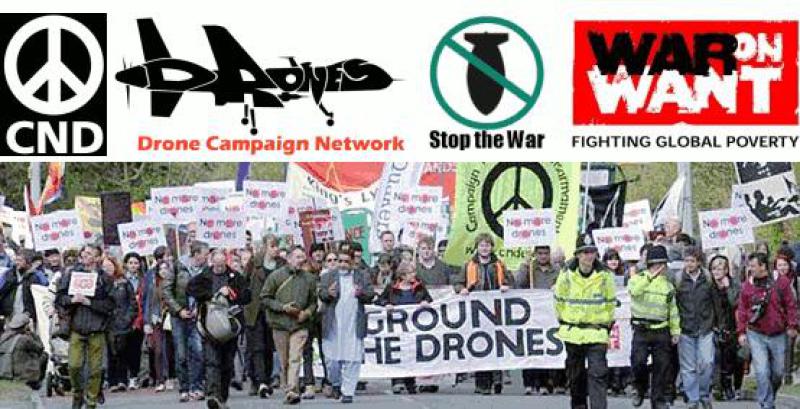
Hundreds of peace campaigners gathered Saturday
outside a new Reaper Unmanned Aerial Vehicle control
center in the UK countryside to say it is "time to
end killer drones."
click on photo to enlarge
In what is being called the UK's biggest anti-
drone protest to date, over 400 demonstrators took
part in a march and rally outside of the UK's new
drone headquarters at the Royal Air Force (RAF)
Station Waddington in Lincolnshire, three hours
north of London.
According to a local news outlet, demonstrators
carried banners and drums and marched chanting:
"David Cameron, CIA, how many kids have you killed
today?" and "War's not a video game, every Afghan
has a name."
A protester identified as Ms. John told the crowd
outside the compound, "This base is a smokescreen
for the work that's going on in killing children
across the world."
Saturday's rally and march was organized by the
Campaign for Nuclear Disarmament (CND), the Drone
Campaign Network, Stop the War Coalition and War on
Want.
According to The Guardian, the British Ministry of
Defense began carrying out missile-carrying Reaper
aircraft missions from the newly built headquarters
earlier this week.
Previously, the RAF had been piloting the unmanned
aircraft in attacks against Afghanistan from the
Creech airforce base in Nevada.
Ahead of the protest, War on Want senior campaigns
officer for militarism and security, Rafeef Ziadah
said in a statement, "Drones, controlled far away
from conflict zones, ease politicians' decisions
to launch military strikes and order extrajudicial
assassinations, without democratic oversight or
accountability to the public. Now is the time to
ban killer drones – before it is too late."
"It's time to end this remote killing before even
more innocent civilians are slaughtered - they are
the main victims in this barbaric form of high-tech
killing," added Kate Hudson, general secretary for
the Campaign for Nuclear Disarmament.
"I think there's something quite sinister about
the idea that military personnel in Lincolnshire
can press a button and take out and kill unnamed
targets in Afghanistan and Pakistan or wherever,"
said Chris Nineham, vice-chair of the Stop the War
Coalition.
"Drones are being used to continue the deeply
unpopular War on Terror, with no public scrutiny,"
he added. "They're using them to fight wars behind
our backs."
Reportedly, the RAF has purchased five more Reaper
aircraft—bringing the total to 10—which they are
expected to deploy in Afghanistan over the summer.
British UAVs have flown 45,000 hours in
Afghanistan, and fired 350 weapons, including
Hellfire missiles.
|


|
DISCUSSION
Question(s) related to this article:
Drones (unmanned bombers), Should they be outlawed?
* * * * *
LATEST READER COMMENT:
Finally a Drone Report Done Right
By David Swanson
The U.N. and Human Rights Watch and Amnesty International recently released a flurry of deeply flawed reports on drone murders. According to the U.N.'s special rapporteur, whose day job is as law partner of Tony Blair's wife, and according to two major human rights groups deeply embedded in U.S. exceptionalism, murdering people with drones is sometimes legal and sometimes not legal, but almost always it's too hard to tell which is which, unless the White House rewrites the law in enough detail and makes its new legal regime public.
When I read these reports I was ignorant of the existence of a human rights organization called Alkarama, and of the fact that it had just released a report titled License to Kill: Why the American Drone War on Yemen Violates International Law. While Human Rights Watch looked at six drone murders in Yemen and found two of them illegal and four of them indeterminate, Alkarama looked in more detail and with better context at the whole campaign of drone war on Yemen, detailing 10 cases. As you may have guessed from the report's title, this group finds the entire practice of murdering people with flying robots to be illegal.
Alkarama makes this finding, not out of ignorance of the endless intricacies deployed by the likes of Human Rights Watch and Amnesty International. Rather, Alkarama adopts the same dialect and considers the same scenarios: Is it legal if it's a war, if it's not a war? Is it discriminate, necessary, proportionate? Et cetera. But the conclusion is that the practice is illegal no matter which way you slice it.
This agrees with Pakistan's courts, Yemen's National Dialogue, Yemen's Human Rights Ministry, statements by large numbers of well-known figures in Yemen, and the popular movement in Yemen protesting the slaughter. While the other \"human rights\" groups ask President Obama to please lay out what the law is, whether his killing spree is part of a war or not, who counts as a civilian and who doesn't, etc., Alkarama actually compares U.S. actions with existing law and points out that the United States is violating the law and trying to radically alter the law. This conclusion results in a clear and useful set of recommendations at the end of the report, beginning with this recommendation to the U.S. government:
\"End extrajudicial executions and the practice of targeted killings by drones and other military means.\"
This recommendation is strengthened by a better informed and more honest report that much more usefully conveys the recent history of Yemen (including by noting honestly the destructive impact of the IMF and the USA), describes the indiscriminate terror inflicted by the buzzing drones, and contrasts drone murders to alternatives -- such as negotiations. This analysis enriches our understanding of why drone wars are counterproductive even from the point of view of a heartless sociopath rooting for Team USA, much less someone concerned about human rights.
It is, then, possible to write a human rights report from a perspective concerned with the rights of humans, and not some combination of concern with human rights and devotion to U.S. imperialism. This is good news for anyone interested in giving it a try. The field is fairly wide open.
Some nations' statements at the U.N. debate on drones this month, including Brazil's, also challenged the legalization of a new form of war. And all of these groups and individuals have something to say about it as well.

|
|



 by program area