|
|
UN Counter-Terrorism Expert to launch inquiry into the civilian impact of drones and other forms of targeted killing
an article by Office of the High Commissioner for Human Rights
The United Nations Special Rapporteur on human rights and counter-terrorism, Ben Emmerson, will formally launch on Thursday 24 January 2013 an inquiry into the civilian impact of the use of drones and other forms of targeted killing, focusing on the applicable legal framework, a critical examination of the factual evidence concerning civilian casualties, with a view to making recommendations to the UN General Assembly concerning the duty of States to conduct effective independent and impartial investigations into the lawfulness and proportionality of such attacks, to be presented later this year.
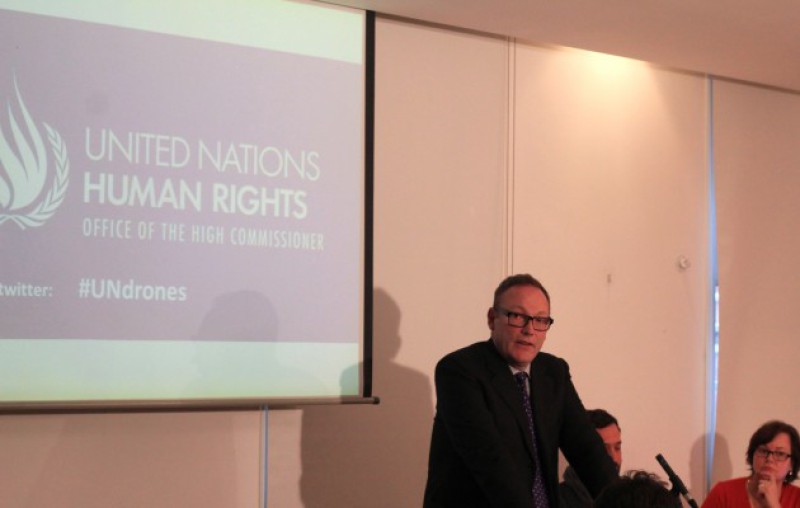
Ben Emmerson QC addresses reporters in London (Photo: TBIJ, from website http://www.thebureauinvestigates.com)
click on photo to enlarge
The inquiry will be launched publicly at a press conference this Thursday, 24 January 2013, to be held at 11:00 GMT, at Matrix Chambers, Griffin Building, Grays Inn, London WC1R 5LN. The Special Rapporteur will make a statement setting out the aims and objectives of the inquiry, its modalities and time-frame. He will also announce the names of the experts and other personnel who will be involved in the inquiry.
Ben Emmerson (United Kingdom) is the Special Rapporteur on the promotion and protection of human rights and fundamental freedoms while countering terrorism. On 1 August 2011, he took up his functions on the mandate that was created in 2005 by the former United Nations Commission on Human Rights and renewed by the United Nations Human Rights Council for a three year period in September 2010. As Special Rapporteur he is independent from any Government and serves in his individual capacity. Learn more, log on here.
|


|
DISCUSSION
Question(s) related to this article:
Drones (unmanned bombers), Should they be outlawed?
* * * * *
LATEST READER COMMENT:
Finally a Drone Report Done Right
By David Swanson
The U.N. and Human Rights Watch and Amnesty International recently released a flurry of deeply flawed reports on drone murders. According to the U.N.'s special rapporteur, whose day job is as law partner of Tony Blair's wife, and according to two major human rights groups deeply embedded in U.S. exceptionalism, murdering people with drones is sometimes legal and sometimes not legal, but almost always it's too hard to tell which is which, unless the White House rewrites the law in enough detail and makes its new legal regime public.
When I read these reports I was ignorant of the existence of a human rights organization called Alkarama, and of the fact that it had just released a report titled License to Kill: Why the American Drone War on Yemen Violates International Law. While Human Rights Watch looked at six drone murders in Yemen and found two of them illegal and four of them indeterminate, Alkarama looked in more detail and with better context at the whole campaign of drone war on Yemen, detailing 10 cases. As you may have guessed from the report's title, this group finds the entire practice of murdering people with flying robots to be illegal.
Alkarama makes this finding, not out of ignorance of the endless intricacies deployed by the likes of Human Rights Watch and Amnesty International. Rather, Alkarama adopts the same dialect and considers the same scenarios: Is it legal if it's a war, if it's not a war? Is it discriminate, necessary, proportionate? Et cetera. But the conclusion is that the practice is illegal no matter which way you slice it.
This agrees with Pakistan's courts, Yemen's National Dialogue, Yemen's Human Rights Ministry, statements by large numbers of well-known figures in Yemen, and the popular movement in Yemen protesting the slaughter. While the other \"human rights\" groups ask President Obama to please lay out what the law is, whether his killing spree is part of a war or not, who counts as a civilian and who doesn't, etc., Alkarama actually compares U.S. actions with existing law and points out that the United States is violating the law and trying to radically alter the law. This conclusion results in a clear and useful set of recommendations at the end of the report, beginning with this recommendation to the U.S. government:
\"End extrajudicial executions and the practice of targeted killings by drones and other military means.\"
This recommendation is strengthened by a better informed and more honest report that much more usefully conveys the recent history of Yemen (including by noting honestly the destructive impact of the IMF and the USA), describes the indiscriminate terror inflicted by the buzzing drones, and contrasts drone murders to alternatives -- such as negotiations. This analysis enriches our understanding of why drone wars are counterproductive even from the point of view of a heartless sociopath rooting for Team USA, much less someone concerned about human rights.
It is, then, possible to write a human rights report from a perspective concerned with the rights of humans, and not some combination of concern with human rights and devotion to U.S. imperialism. This is good news for anyone interested in giving it a try. The field is fairly wide open.
Some nations' statements at the U.N. debate on drones this month, including Brazil's, also challenged the legalization of a new form of war. And all of these groups and individuals have something to say about it as well.

|
|



 by program area