|
|
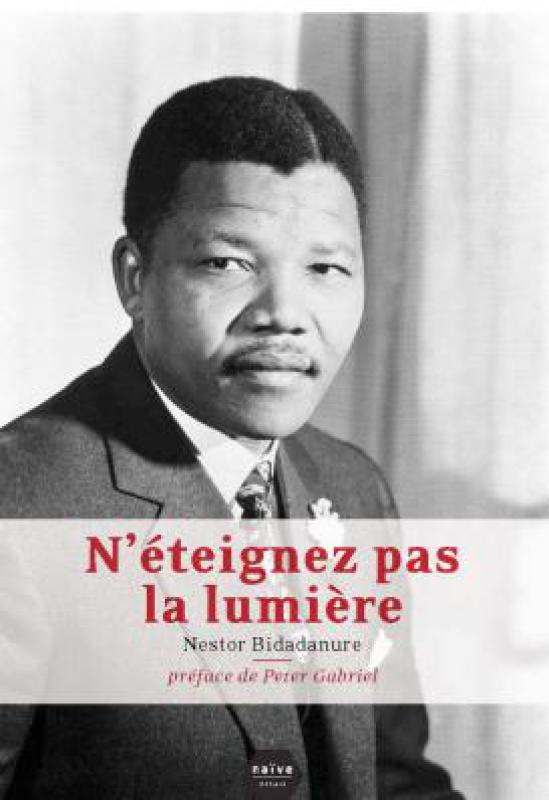
Do not turn off the light - a book review
an article by Sodis, Editions Gallimard
"It was during the 30s, in a pro-Nazi organization
called Ossewa Brandwag (the Oxcart Sentinel) that
the three precursors of apartheid. John Vorster ,
Verwoerd Hendrik Frensch and Daniel Malan met and
shared two sinister dreams. The first was to take
power to avenge the British rule over the
Afrikaners. The second was to make a
hierarchical racial system in which blacks would
be further marginalized. To achieve these
objectives, these men needed two key levers : a
shared vision of the world, a doctrine, a
political party to mobilize the mass of whites.
The system of apartheid thus became the doctrinal
response and the National Party 's instrument of
propaganda, organization and conquest of powe.
But what is the meaning of apartheid? What is the
real meaning of the doctrine?"
click on photo to enlarge
"Do not turn off the light" is a book of
reflections on the thought of Nelson Mandela. It
analyzes the conditions for the emergence of his
political personality as well as his legacy for
future struggles. The light symbolizes culture in
the progressive and humanist sense. It springs
from traditional education, the African philosophy
of Ubuntu, the willingness to learn and the
conclusions that the hero of the struggle against
apartheid draws from each political struggle .
Mandela believes that every human being can better
himself, and that education raises the human
condition and makes people free. To survive the
harsh conditions of imprisonment, Mandela and his
companions put in place a strategy of resolute
resistance. Neither terror nor subhuman prison
conditions designed to break the morale of the
prisoners could defeat the freedom fighters .
The author, Nestor Bidadanure, is a journalist and
specialist in conflict resolution. He contributes
to the magazine Afrique-Asie . He is the author of
the books "Cultures of peace versus populism" and
Memoirs of the future" in the "Naive" editions
(2011).
(Click here for a French version of this article)
|


|
DISCUSSION
Question(s) related to this article:
What is the legacy of Nelson Mandela for us today?,
* * * * *
LATEST READER COMMENT:
ON MANDELA'S LASTING LEGACY
In death, as in his life, Nelson Mandela has captured the imagination of the world. Mourning mixed with celebration has electrified crowds all over South Africa and elsewhere. His life’s achievements and his lasting legacy are the topics of discussions. He has been described as a great warrior, a great liberator, the last giant in the fight against colonialism, forgiver, peace maker, and in many other ways.
All this week, Mandela’s lasting legacy has been on my mind. We tend to capture the legacies of great men and women in a word or two. A scientist becomes famous for an important discovery, a writer for a famous book, a musician for a great composition, and so on.
People like Mandela fall in a different category. He is in the category of Mahatma Gandhi and Dr. Martin Luther King. They are known for their fights on behalf of oppressed people; they are known for their personal sacrifice, and for their moral authority. If we are to look for words to associate with these men, it will be ?nonviolence? for Gandhi and ?love? (beloved community) for Dr. King. But what about Mandela- how will we describe his legacy?
What were the important transformational changes in Mandela?s life?
Mandela the great warrior: Mandela has been described as a great warrior, but he was no ordinary warrior. All legendary warriors, mythical or real, are known for the destruction of their enemies. Mandela was different; he did not seek annihilation of his enemy; he transformed his enemy into his collaborator.
Mandela the resilient sufferer: I know of no other person living or dead who was forcefully made to disappear from the scene for this long (incarceration for 27 years) and who survived and made his triumphatic return. Gandhi said there is no other way to show your love for the suffering of your loved ones than to suffer yourself with them, for them. Mandela suffered the longest because his work was the hardest.
Mandela the great liberator: Colonial rulers are known for their ruthless treatment and putting down of citizens but South Africa was not a typical colonial rule. The rulers were Afrikaners, citizen of South Africa. I know of no other country, outside of the United States, where the blacks were so harshly treated by another segment of their own country. It was a true liberation. Thanks to Mandela, sad songs of seeking freedom through death were transformed into freedom in life.
Mandela the magnanimous forgiver: Gandhi?s nonviolence is a complete philosophy of life and it includes love of your enemy and forgiveness. Nonviolence had to be tested to show that it works and that it?s not just a philosophy. Dr. King tested nonviolence with his own suffering and love for his people. His passion for his ?beloved community? became the brand of his civil rights struggle for which he paid with his own life. As Gandhi said, the only two places of non-action for such fighters are prison or death. Mandela went to prison, suffered longer, and tested his resolve to forgive his ?enemy?. We can only imagine the blood bath had he not done that.
Mandela the peace maker: Gandhi, Dr. King and Mandela, together, constitute a shining trinity of peace and their contributions, respectively, nonviolence, love, and forgiveness provide a prescription for peace if the humankind needs to survive. Truth and Reconciliation will remain one of Mandela?s brilliant and innovative contributions for healing wounds between warring people, warring nations. Gandhi, King and Mandela, all tested nonviolence in their own way and they all came out with the same result: The path of peace and liberation goes through love, suffering, and forgiveness.
Mandela the spiritual father: We go through life with two sets of parents. Our own parents, of course, who brought us in this world, whom we owe our life, body and brain, whom we remain eternally grateful for their sacrifice and care to help us grow and to teach us how to live.
There are another set of parents, for a lack of a better word we can call them our ?spiritual parents?. These are men and women whom the whole humanity owes gratitude because it is their discoveries, contributions and, teachings that we like fill our brain with, they make us human- kinder, gentler, and humane.
We call ourselves human because we made a pledge with destiny that we will become humane. It has been a long and arduous journey. With his love, suffering and forgiveness, Mandela has brought us further on the path and has warned we still have a long way to go.
Gandhi-King-Mandela, or Mohan, Martin and Matiba, are angels of peace. We are their descendents, the keepers of their dreams.
Rama Singh, is a professor in the department of biology, and member, Coordinating Council, Centre for Peace Studies, McMaster University.
This appreciation was originally published in the Hamilton Spectator in Canada.

|
|



 by program area