|
|
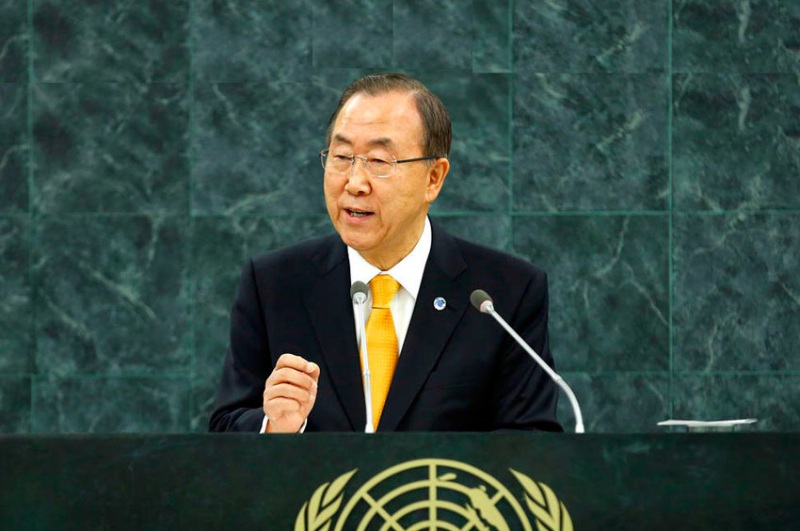
‘The World Is Watching and Expectations Are High’, Secretary-General Says at Intergovernmental Negotiations on Post-2015 Development Agenda
an article by UN Secretary-General Ban Ki-moon: remarks to the Intergovernmental Negotiations on the Post-2015 Development Agenda (abridged)
Thank you, Mr. President, for organizing this important meeting
today, at the beginning of this new year. I am particularly
encouraged by such a strong participation of all the Member
States. This room is completely crowded. I can feel the
excitement and energy and passion coming from the floor. This
is a good sign at the beginning of this year, when you are now
beginning this important intergovernmental negotiation on this
issue . . . 
click on photo to enlarge
We now begin a seminal year, which should kick-start a new era
of sustainability for all humankind. Member States have the
extraordinary opportunity — and the responsibility — to agree a
far-reaching vision to 2030; to adopt an inspiring set of
sustainable development goals; to make sure that they are
adequately financed; to address human-induced climate
change; and to rigorously monitor and review progress, so that
the transformation we seek becomes a reality. . .
In the year ahead, we will meet on three continents to usher in a
new era of sustainable development. In July, we will gather in
Addis Ababa to pave the ground for bold actions on financing
and the global partnership for sustainable development. In
September, here in New York, leaders will converge for the
United Nations special summit for the adoption of a universal
and transformative post-2015 development agenda, including
the sustainable development goals. And in December, the
twenty-first Conference of United Nations Framework
Convention on Climate Change (UNFCCC) will meet in Paris to
adopt a legal framework for a meaningful, universal climate
change agreement. . .
In the coming months, you will negotiate the final parameters of
this agenda. It is clear that it should include a compelling and
principled narrative, based on human rights and human dignity.
It will have the sustainable development goals at its core. It will
require a global partnership to help mobilize financing and other
means of implementation. And it should include strong public
mechanisms at all levels for sharing knowledge, reporting,
reviewing progress, learning lessons and ensuring that everyone
delivers on their commitments. . .
The world is watching and expectations are high. Let us
demonstrate that we are determined to work together to build a
better life and a brighter future for the most vulnerable, their
children and their grandchildren. Let us show those who bear
the brunt of poverty, disease, inequality, climate change and
conflict that we can build a better world, based on solidarity,
trust and mutual responsibility. Let us demonstrate global
citizenship, foresight, moral courage and political leadership as
we reach final agreement on plans to support people,
communities, societies and our beautiful planet. . .
|


|
DISCUSSION
Question(s) related to this article:
Sustainable Development Summits of States, What are the results?
* * * * *
LATEST READER COMMENT:
Here is a translation of an analysis of Rio+20 by Candido Gryzbowski, one of the initiators of the World Social Forums. For the original Portuguese, click here.
Where are we? Where are we going? How should we imagine our common destiny in intimate relationship with nature? How can we construct conditions of living and happiness for all human beings, without distinction, caring and sharing the planet that houses us? What changes do we need in the ways we organize, produce and consume, in the production of social exclusion and inequity which destroy the very basis of life? These are our questions at the end of the Rio +20 Conference, where once again our leaders have shown a lack of determination to start a major reconstruction of a world in crisis. We have see much official pomp for nothing, creating even more uncertainty about our collective ability to change directions for the sustainability of life, all life forms, and for the integrity of the Earth. Meanwhile ... the crisis deepens and widens and the collective uncertainty increases. Rio +20 has nourished the destructive capacity of the global crisis, rather than seizing the historic moment and making the changes that are urgently needed.
We say loud and clear that the multifaceted crisis (climate and environmental, financial, food, values...), which engulfs the whole world, also has another component: the crisis of governance. This is revealed on the one hand, in the absence of a structure of global legitimate power more than what we have today. Multilateralism is exhausted and powerless against the constant threat of armed imperialism and its power of veto. It clashes with the interests of states and national sovereignty. It is essential to add to this synthetic evaluation that the global economy today and the very health of public finances depend on the enormous power of private economic-financial corporations, for which the interests of the world are secondary to their interests of accumulating wealth. We have a world government of corporations rather than states.
On the other hand, the crisis of governance appears not only in the total lack of vision and will to change by governments but also by the parliaments that sustain them, however limited and contradictory, within the political space that they still keep calling on the power of markets.
Even if impossible, the major tasks in the history of mankind have always been, to begin with, thoughts and dreams, before creating the conditions that made them possible. Considering the state of the world today and the pathetic Rio +20 Conference, we find a lack in the world arena of leaders with a broad political and ethical vision, generous and committed, who hear voices of the people and respond to the demands of rising global citizenship. We need leaders who can define directions and agreements to establish democratic processes of change here and now.
It is worth noting here that the failure of the Rio +20 was somehow expected. I even wrote a series of articles about it. But there was a glimmer of hope that something could happen and the outcome could be different. After all, politics, even democratic politics, always has some unpredictability in its results, at least regarding when and how. But this time, \"efficiently\" diplomacy supported the lowest common denominator, which ended up below the minimum of UNCED 1992 and below the expectations of public opinion and the various voices of the world citizens. As always, there is something positive to point out in producing this empty conference: the green economy, which they tried to sell as sustainable development, failed to receive consensus and agreement. The big corporations, that are celebrating the collective failure of established power to change the organization of the world economy, can not celebrate total victory, because they were not given the freedom to do business without any regulation, assaulting nature with biotechnology, nanotechnology, and geoengineering. But the fight is not over.
What we missed more forcefully in Rio +20 was the birth of a planetary citizenship. The time has come for an irresistible movement of citizenship for another history. We tried to prepare for this and we came in reasonable numbers. Not a few of us participated in the People's Summit, and also in the distant Riocentro. As always, some of us exercised our citizen diplomacy and tried to influence the production of the final document. We showed, especially in Flamengo Park, the vibrant and even joyful diversity of people housed by the Planet Earth. But it must be acknowledged, we lacked the people and we lacked the power to create a real democratic political force capable of reversing the game or at least threatening to do so. Also, we could not overcome our fragmentation and echoing noise. We achieved little in terms of paths for new paradigms, which was the motto that united us. We showed anger, insurgency and capacity for mobilization , but we did not yet come up with the ideas and proposals that can unite multiple and diverse dreams of many and diverse social and cultural identities, pluralism of views, analyses and ways of acting. The inability of governments in the face of their contradictions, and especially of corporate power, once again made clear in this UN conference, can only be overcome by our determination as citizens and responsible citizens, to believe and act so that other worlds are possible. We should have no illusions: it is up to us to make governments change.

|
|



 by program area